Traveller's Tale | Jaipur | Gustasp and Jeroo Irani
Re-visit some of Jaipur's architectural marvels and its hidden treasures
👤 Gustasp and Jeroo Irani 🕐 5 min
We weren't debutante tourists in Jaipur but repeat visitors enthralled by an enchanting city. Over several visits, we had explored most of Jaipur's awesome roster of attractions and realised that the city's sights could give other great metros an inferiority complex. Throw in unforgettable cameos of proud locals in colourful turbans and handlebar moustaches — village belles in swirling skirts and chunky silver jewellery and proud camels squatting in the sand. Soon, Jaipur begins to resemble a stage set up with extravagant props.
But it's all very real and we decided to re-visit some of its known architectural marvels and scoop out some of its hidden treasures as well. A quick stop at the 18th century Hawa Mahal or Palace of Wind wasn't enough. Locals ushered us up narrow stairs, above a warren of shops opposite the monument, to get picture-postcard-perfect photographs of the palace. The pink, five-storey palace, honey-combed with over 150 latticed windows enabled ladies to watch unseen life and processions swirl on the broad street below. On a terrace across Hawa Mahal, perched precariously on a parapet, some selfie-struck tourists posed, pirouetted and pouted in front of cell phones held aloft to get the palace as a backdrop to their preening selves.
One of the country's first planned cities, the origins of Jaipur go back to 1727 when Jai Singh II, Raja of Amer, traded his grand palace within the fortified walls of Amer Fort for an even more magnificent city, to be named after him. Jaipur was dubbed the Pink City in 1876 when Sawai Ram Singh I who had the city painted pink in honour of the visit of Prince of Wales', who was later crowned King Edward VII. Ever since, and even today, the city has been getting a coat of fresh paint every once in a while.
To escape the traffic-clogged streets of the old city, we retreated for a while into the rambling City Palace, a maze of cool courtyards, gardens and palaces from different eras where royal memorabilia is on display. There we stumbled on a Craft Centre where visitors can view and buy goods directly from craftsmen and artists personally selected by a member of the royal family and asked to set up shop.
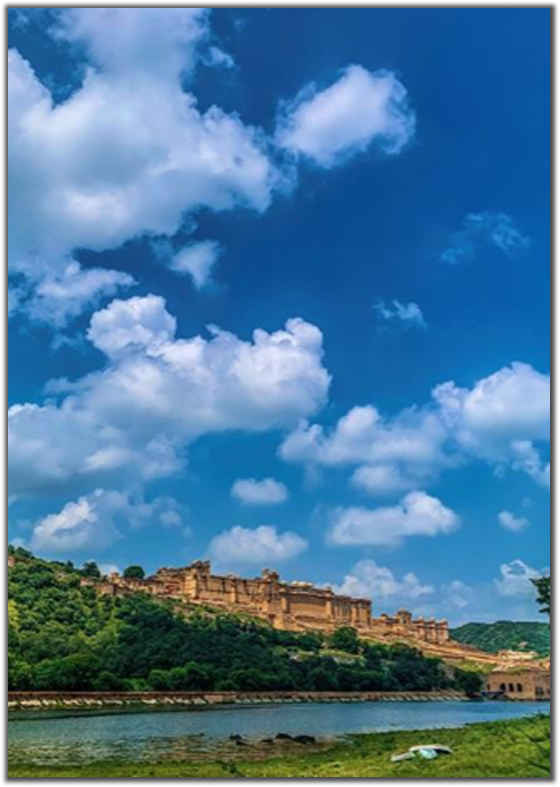
On our last evening, we headed for Amer Fort, the former capital. The 16th century Amer Fort is another eyeful and as the fading light of a post-sunset sky brushed its ramparts, we quickly explored its labyrinthine but stunning interior. Massive arched gates protect the outer courtyard which is dominated by the many-arched Diwan-e-Aam or hall of public audience.
The city that never sleeps meets travelers
who never settle
New York
On our last evening, we headed for Amer Fort, the former capital. The 16th century Amer Fort is another eyeful and as the fading light of a post-sunset sky brushed its ramparts, we quickly explored its labyrinthine but stunning interior. Massive arched gates protect the outer courtyard which is dominated by the many-arched Diwan-e-Aam or hall of public audience.
The main palace complex is tucked away behind walls and archways alive with a mosaic of inlaid images. The magnificent Diwan-e-Khas or hall of private audience, elaborate gardens and courtyards, a hall of mirrors that recreates star-studded night skies, the private residential quarters of the king and his queens cooled by breeze blowing across channels of water and filigreed walls with delicate designs speak eloquently of a love for opulence.
And as the sky darkened, the Sound and Light show brought the past back to centre stage once again as in a dramatic play, the story of Amer Fort unfolded. Twenty-eight kings of the Kachwaha dynasty ruled from this impressive fort till the capital was moved to Jaipur. Local legends and folk music enhanced the delve-into-the-past experience while the stunning setting of the Amer Fort and Palace complex in the foreground and the Jaigarh Fort to the left, back-dropped by shadowy hills reverberated with the thunder of battle and galloping horses; the thrust and parry of swords, the cries of fallen soldiers, and of bereft princesses left grieving in their opulent citadels.
After the show, we headed to Sahu Restaurant in the old city to warm up. Sahu, famed for its hot milky tea served in an earthen kulhad, turned out to be a hole-in-the wall tea stall which was set up by the present owner's grandfather and is now a popular "watering hole" for locals.
But it was at the over 50-year-old Rawat Mishtan Bhandar (a takeaway with a restaurant attached) that we found the flavours of Jaipur packaged into crispy mava, potato and onion kachoris; mirch vadas, lassi, sweets and other delicacies. A magnet for locals and the Indian diaspora visiting Jaipur, we were told that the kachoris are carried all the way to the US and last for seven days when refrigerated.
Our voyage of discovery ended with a taste of succulent local specialities at a local eatery, dishes like Laal maas and Gatta curry for which Rajasthan is famed. We were aware that in this Land of Kings, we were biting into hefty chunks of history.