Indigo, The Blue Gold of India | Jaipur |Dharmendar Kanwar
Unravel the world of Indigo with Brij Ballabh Udaiwal at his workshop
👤 Dharmendar Kanwar 🕐 5 min
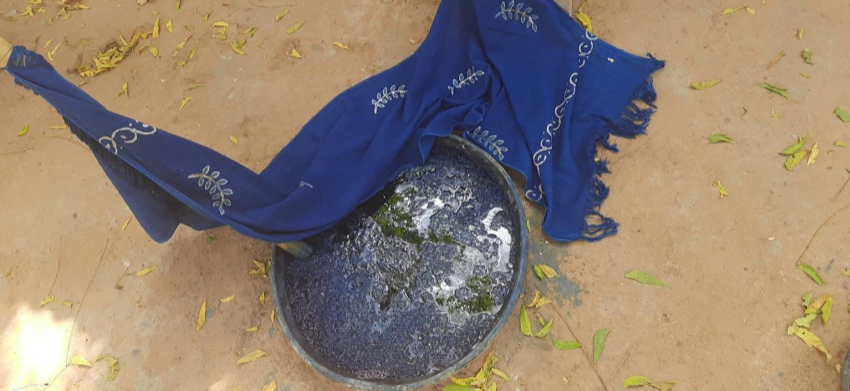
If the world of fabrics and dyes excite you then here’s your chance to attend a unique workshop with the well-known printer and expert Brij Ballabh Udaiwal near Jaipur. Here, you can translate into reality one's dreams about patterns and colours while he and his team help you in unravelling the world of natural Indigo, a natural dye that has been used for thousands of centuries! The oldest surviving fabric dyed with Indigo dates back over 6,000 years ago, from Huaca Prieta in Peru.
This magical shade of blue, often called Indigo, is extracted from the Indigofera plant which grows in the wild, and the art of extracting color from the natural way has been known in India for about 4000 years since the time of Indus Valley Civilization. From Mohenjo Daro, archaeologists have recovered seeds as well as the remains of cloth dyed in Indigo blue. This color (blue dye) was exported from the ancient silk route to the Mediterranean region where it fetched a high price. The dye was also known in the ancient civilizations of Mesopotamia, Egypt, Peru, and Africa. Besides its use in dyeing yarns and fabrics Indigo is also used as an antiseptic, as a hair dye combined with mehndi, and also in paint and ink. It was a luxury item, imported by Arab traders from India to the Mediterranean Sea.
Indigo remained a rare commodity in Europe throughout the Middle Ages. In 1498, Portuguese explorer Vasco da Gama discovered a sea route to India, which opened direct trade with the subcontinent. With this, Indigo reached the shores of Europe and became accessible to the average European. Arab traders had carried Indigo-dyed clothes to trade centers such as Cyprus, Alexandria and Baghdad, from where they were sent to Italian merchants who introduced them to Europe but the amount of travel and expected profits by many middlemen made Indigo very expensive.
The blue color, which is extracted from the leaves of the Indigo plant through the process of fermentation, does not require any other mordent of any kind for dyeing. There is something mysterious about Indigo dye, which gradually reveals its color after the material is released from the mat after dyeing. When processed properly, Indigo blues have the fastest color. Natural fibers such as cotton, silk, jute, linen and wool can be dyed in Indigo.
The Indigo trade flourished in the subcontinent and Rajasthan was cultivating Indigo and extracting the deep rich blue dye from it as the subtropical climate of region was favourable to Indigo cultivation, almost until the beginning of the 20th century. Many surviving members of the dyer community in Rajasthan, such as the Neelgar and Rangreez and the block printers like the Chippa, Bhavsar and Khatri attest to this fact. But slowly printers and dyers started incorporating new technologies and cheaper dyes thus making Indigo lose its worth.
The city that never sleeps meets travelers
who never settle
New York
It was in 2015 that the Indigo dying process was revived once again in Rajasthan with the combined efforts of the dyer community and an initiative where Brij Udaiwal played a major role and spared no effort in keeping the movement alive. It wasn't an easy journey as the chhipas or printers had moved on to other, more modern, methods of dyeing and printing and were reluctant to go back to this traditional, and rather tedious process.
And as the sky darkened, the Sound and Light show brought the past back to centre stage once again as in a dramatic play, the story of Amer Fort unfolded. Twenty-eight kings of the Kachwaha dynasty ruled from this impressive fort till the capital was moved to Jaipur. Local legends and folk music enhanced the delve-into-the-past experience while the stunning setting of the Amer Fort and Palace complex in the foreground and the Jaigarh Fort to the left, back-dropped by shadowy hills reverberated with the thunder of battle and galloping horses; the thrust and parry of swords, the cries of fallen soldiers, and of bereft princesses left grieving in their opulent citadels.
“We follow the traditional vat making process resulting in Indigo color which is completely natural and available in various shades of Indigo exactly like the neck of a peacock. I hope my awareness campaigns for natural Indigo colour will definitely bring changes and people will understand the benefits of natural Indigo!” says Brij Ballabh Udaiwal.
For information on workshops contact Brij Ballabh Udaiwal +91 9314505805