Romancing the lake city | Udaipur | Chitra Narayanan
The 4th most romantic city in the world, it's best enjoyed during the monsoons
👤 Chitra Narayanan 🕐 4 min
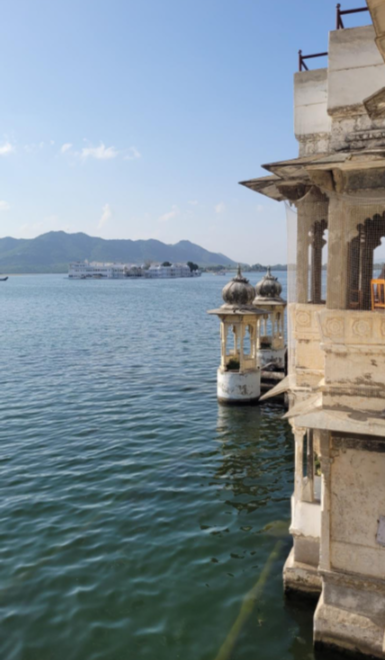
As our flight nears Udaipur, its sobriquet – the city of lakes – seems very apt. We fly over several picturesque water bodies, ringed by green hillocks, before touching down at the airport. The verdant landscape is very different from the other big cities of the desert state.
Getting out of the airport, and walking smack into a noisy welcome party waiting with flowers and musical instruments, it seems Udaipur deserves another sobriquet – the city of weddings. Indeed, our flight was full of people either going for weddings or checking out resorts for marriage purposes.
Agra may be India’s city of love, but Udaipur is the city of romance – it has been voted as the fourth most romantic city in the world. There is the romance of its royal past, there is the romance of the rain (it is best enjoyed during the monsoons, and even a Monsoon Palace built by the erstwhile Maharaja to get the real experience), there is the romance of boating at sunset on the lakes and the romance of regal repasts.
The best place to stay in Udaipur is in the bustling bylanes near Lake Pichola or if you can afford it at one of the palace hotels. From budget to ultra luxury, Udaipur spoils you with plenty of choice when it comes to hotels– you can stay at converted haveli hotels, palace hotels, or charming boutique budget stays from the roofs of which you get to see the pretty lake, ringed by the Aravallis. Of course, the other lakes – Fatehsagar, etc – too have good hotels, but for the old city atmosphere, it’s best to be situated near Lake Pichola. A ferry ride on the lake is a must-do trip, with the enchanting JagMandir island palace at the centre, and the spectacular facade of the pride of Mewar – City Palace – on one of the banks.
To explore the charms of the older parts of the city, it's best to hire an auto or go by foot as the bylanes are extremely narrow and cars will surely get jammed. But if you choose to walk, as I did initially, you will not cover much as you can’t stop halting every few minutes to take pictures or admire some quaint old haveli or peep into shops selling handicraft and Bandhani stoles and sarees. But somehow I manage to get past the Chandpole gate and eventually reach Gangaur Ghat, the lakeside bathing ghat, which has a heritage feel to it, with its magnificent regal arcade. A quaint temple on one side, a little boy running around the ghat that set hundreds of pigeons fluttering in the air lend themselves to picturesque moments at the scenic ghat.
The city that never sleeps meets travelers
who never settle
New York
Near the ghat is the Bagore ki Haveli, which is now a museum, and although it has a neglected feel to it, it is worth a tour as you get to see Rajasthan’s royal heritage. Several cafes dot the lane leading to the ghat, and I slip into one to enjoy a cuppa.
I have already lingered too long and decided to do a whirlwind tour of the hotspots of the city by auto. The tour reinforces my feeling that it is one of the most charming places in India with many different vibes – the leisurely hangout feel at Fatehsagar lake, with boating, and Chowpatty style snack joints by the side. For architecture and beauty, there is the City Palace, which takes many hours to cover, the monsoon palace, and the Jagdish temple. For shopping, a trip to Hathi Pol market is a must – I am entranced by the silver jewellery, marble ware, Bandhani sarees and block print shirts and suit sets. On my return, my attention is caught by a wax museum that features Rajasthan’s rulers.
By now, chatting with a diverse group of locals, I have figured out that I need to come again to visit Shrinathji at Nathdwara, just an hour from the city, and renowned for its pichwai paintings and the special poha on the streets there. Udaipur is also the gateway to Chittorgarh, Mount Abu and Kumbhalgarh Fort. It’s a city that you can keep coming back to and find more and more facets.